
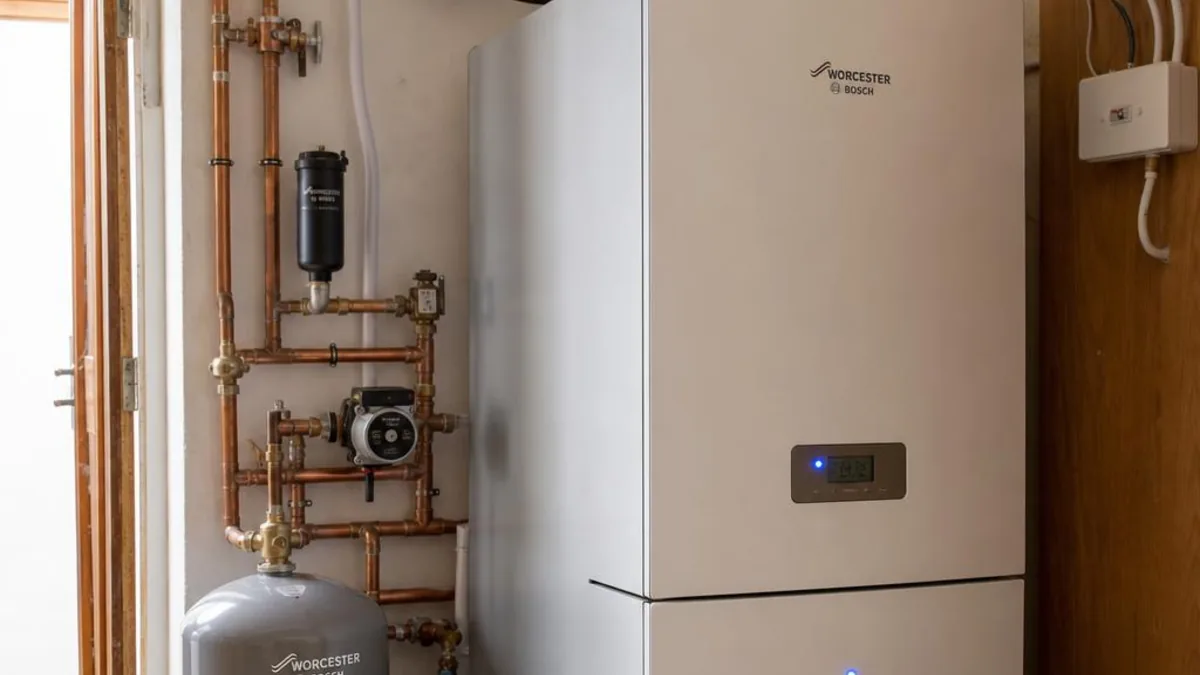
Types of oil boiler
Oil boilers fall into three main configurations, each suited to different hot water and heating needs:
- Regular (heat-only) boilers — work with a separate hot water cylinder and cold water tank in the loft. Common in older properties and those with multiple bathrooms needing simultaneous hot water. The most straightforward to maintain and often cheaper to replace like-for-like.
- System boilers — have many components (pump, expansion vessel) built in, and work with a hot water cylinder but without the loft tank. A tidier installation that is quicker to install than a regular boiler.
- Combination (combi) boilers — provide hot water on demand without a cylinder, similar to a gas combi. They suit smaller homes with moderate hot water demand. Oil combis are less common than gas combis and should be sized carefully — low flow rate is a frequent complaint in poorly specified installations.
Condensing vs conventional boilers
This is the most important distinction in terms of running cost. A condensing boiler recovers heat from the flue gases that a conventional boiler wastes — specifically, it condenses the water vapour in the exhaust and extracts its latent heat. This typically raises real-world efficiency from around 75 to 82% (for an older non-condensing boiler) to 90 to 92% for a modern condensing unit.
Since April 2007, new oil boiler installations in England and Wales have been required to be condensing under Building Regulations Part L. If your boiler was installed before this date and has never been replaced, it is almost certainly non-condensing. Upgrading to a condensing boiler can reduce your fuel consumption by 15 to 20%, saving a typical household £300 to £450 per year on heating oil.
Condensing boilers produce a small amount of acidic condensate (water drained from the flue gases) which must be disposed of correctly — usually piped to an internal drain. This is a minor installation consideration but must be addressed.
Efficiency ratings explained
UK boiler efficiency is expressed as an Annual Fuel Utilisation Efficiency (AFUE) percentage and displayed as an ErP energy label (A++ to G). Oil boilers are also tested under the older SEDBUK (Seasonal Efficiency of Domestic Boilers in the UK) standard. When comparing models:
- A-rated — 90% AFUE or above. All modern condensing oil boilers should achieve this.
- B-rated — 86–90% AFUE. Some older condensing models.
- C-rated or below — below 86% AFUE. Almost always a non-condensing boiler. Replacement is likely to pay back within 3 to 5 years for a high-consumption household.
OFTEC's technical literature for each boiler model shows its SEDBUK rating. The MCS (Microgeneration Certification Scheme) database lists heat pump alternatives if you are considering a switch away from oil.
Boiler sizing
Oversizing a boiler is a common mistake that wastes money. An oversized boiler short-cycles — it fires, reaches temperature quickly, shuts off, then fires again — which reduces efficiency and increases wear. Proper sizing requires a heat loss calculation for your specific property, taking into account floor area, insulation levels, number of radiators and hot water demand.
As a very rough guide for an uninsulated or poorly insulated UK home, allow approximately 100 watts per square metre of heated floor area for space heating, plus 3 kW for domestic hot water demand. A 150 m² three-bedroom house might need a 15–18 kW boiler. An OFTEC engineer will carry out a proper calculation.
Annual servicing
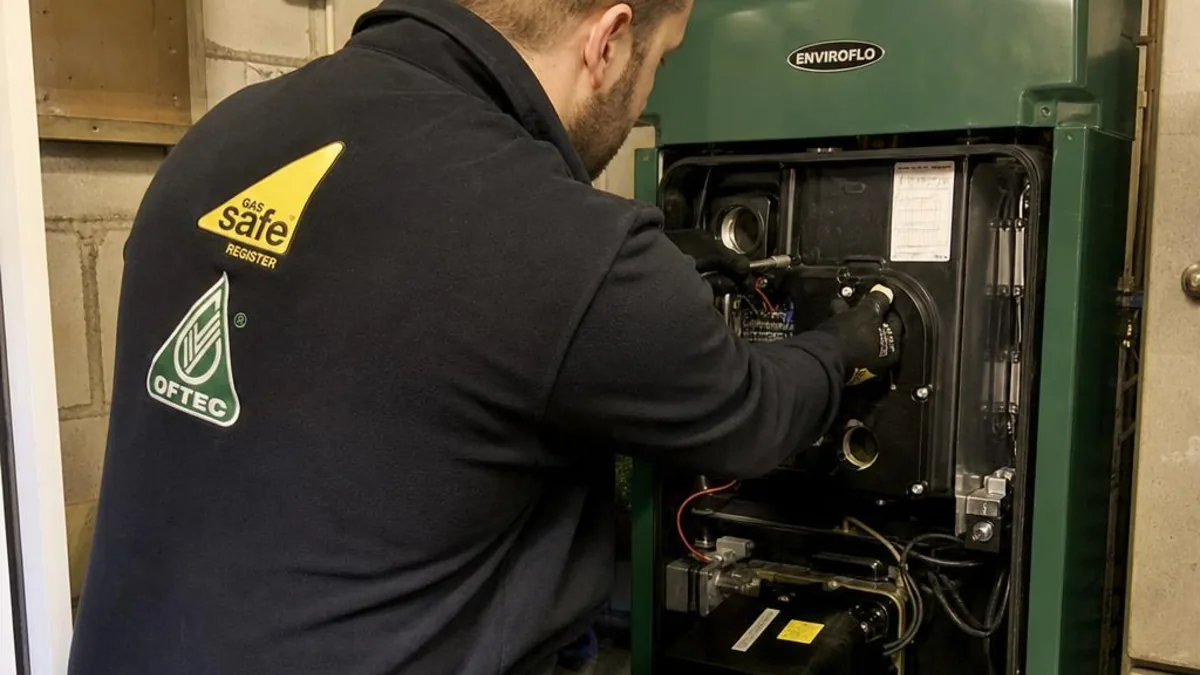
Oil boilers should be serviced annually by an OFTEC-registered engineer. A typical service includes:
- Cleaning and inspecting the burner, nozzle and electrodes
- Checking and cleaning the heat exchanger
- Replacing the oil filter
- Checking flue integrity and combustion efficiency using a flue gas analyser
- Inspecting the pump, fan and controls
- Checking the condensate drain (condensing boilers)
A service typically costs £90 to £150 depending on your region and engineer. It is not optional — skipping a service risks reduced efficiency, increased fuel consumption, premature component failure and, in the worst case, an unsafe flue situation. Many boiler manufacturers require annual service records to maintain the warranty.
Budget for servicing as a fixed annual cost when calculating your total heating expenditure.
Common oil boiler problems
The most frequent reasons for an oil boiler lockout (where the boiler fires but then goes into safety lockout mode) are:
- Blocked fuel filter — caused by sediment from the tank, particularly after a dry-run or tank contamination. Replace the filter and check the tank.
- Worn nozzle — the burner nozzle atomises oil into a fine mist. A worn or partially blocked nozzle causes poor combustion and eventual lockout. Nozzles should be replaced at every service as a matter of course.
- Air in the fuel line — most often caused by running the tank dry. A boiler engineer can bleed the line.
- Faulty photocell — the photocell detects the burner flame. A dirty or failed photocell causes lockout even when the boiler is burning correctly. It is inexpensive to replace.
- Pump failure — the oil pump can seize or wear over time, particularly in boilers that have not been serviced regularly.
Finding an OFTEC engineer
OFTEC (the Oil Firing Technical Association) is the UK's main certification body for oil heating engineers. Only OFTEC-registered technicians can self-certify oil boiler and tank installations under Building Regulations — meaning the work does not need to be separately approved by your local authority. Using an unregistered engineer to install a new boiler or tank is illegal and can void insurance.
Find a registered engineer using the OFTEC technician search at oftec.org. When getting quotes, always ask to see the engineer's OFTEC registration card and check the registration number on the OFTEC website.
When to replace your boiler
Oil boilers typically last 15 to 25 years with regular servicing. Consider replacement when:
- The boiler is non-condensing and your fuel costs are high — the payback on a replacement can be under 5 years for high-usage households
- Repair costs are significant — if the cost of a repair exceeds one year's annual service cost (roughly £100–£150), weigh it against the cost of a replacement
- Parts are becoming difficult to source — older boiler models may have discontinued components
- Your engineer consistently flags concerns about safety or efficiency at service
When replacing, also consider whether a heat pump is suitable for your property. Homes with good insulation and underfloor heating or large radiators are well-suited to air source heat pumps, which attract a government grant of £7,500 under the Boiler Upgrade Scheme (BUS) in 2026. See our rural heating guide for a full comparison of alternatives.