
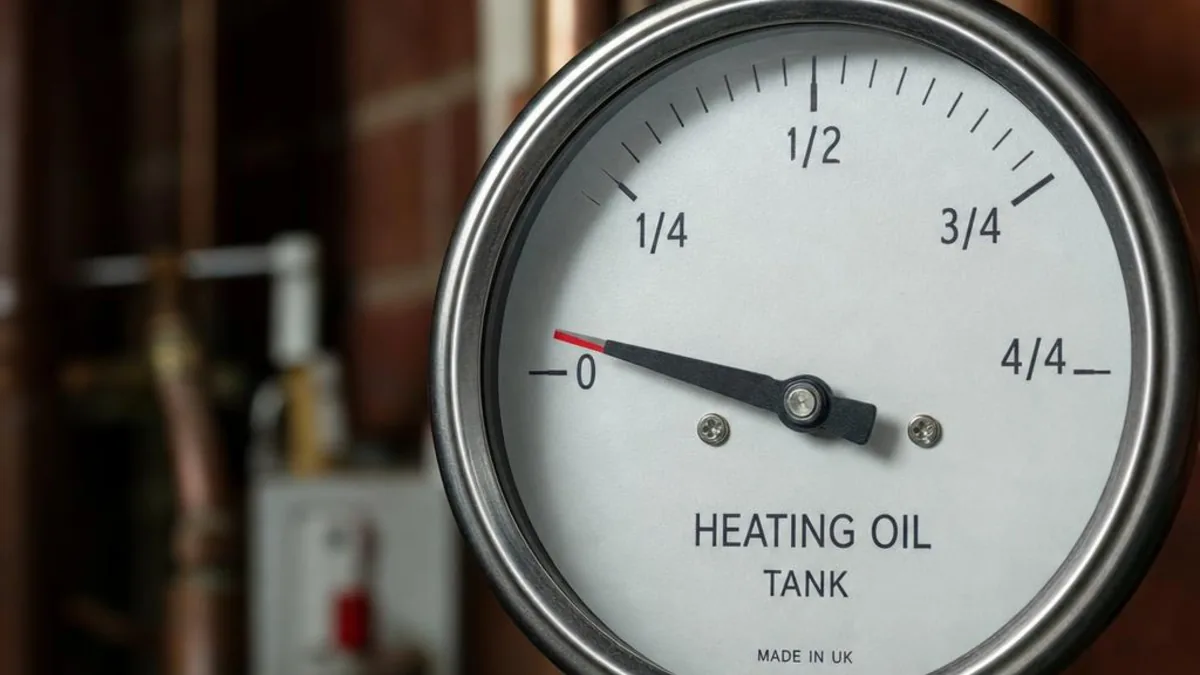
Why running out is costly
Running out of heating oil is one of the most avoidable — and most expensive — problems facing off-grid homeowners. Emergency heating oil typically costs 8 to 15p per litre more than a standard planned delivery. On a 500-litre top-up, that is an unnecessary premium of £40 to £75. In cold weather, when demand is highest, the premium can be even larger and delivery may still take 24 to 48 hours.
Beyond the financial cost, running a boiler dry can introduce air into the fuel line, requiring a boiler engineer to bleed the system before it will restart. That callout typically costs £60 to £120. Some older boilers can also sustain pump damage when they run without fuel. For these reasons, prevention is almost always cheaper than cure.
Know your tank capacity and consumption
The first step to avoiding run-outs is understanding how much oil you use. Your annual consumption depends on:
- Property size — a three-bedroom semi might use 1,800 to 2,500 litres per year; a large detached house 3,500 litres or more.
- Insulation — a well-insulated property with double glazing and loft insulation can use 30 to 40% less oil than an uninsulated equivalent.
- Boiler efficiency — a modern condensing boiler rated at 92% AFUE uses significantly less fuel than a conventional boiler rated at 75%.
- Thermostat settings and occupancy — a family home with children using hot water all day uses far more than a property occupied only in the evenings.
Divide your total annual consumption by 365 to get a rough daily usage figure. Note your tank capacity from the manufacturer data plate or a previous delivery note — common domestic sizes are 1,000, 1,500 and 2,500 litres.
Monitor your level regularly
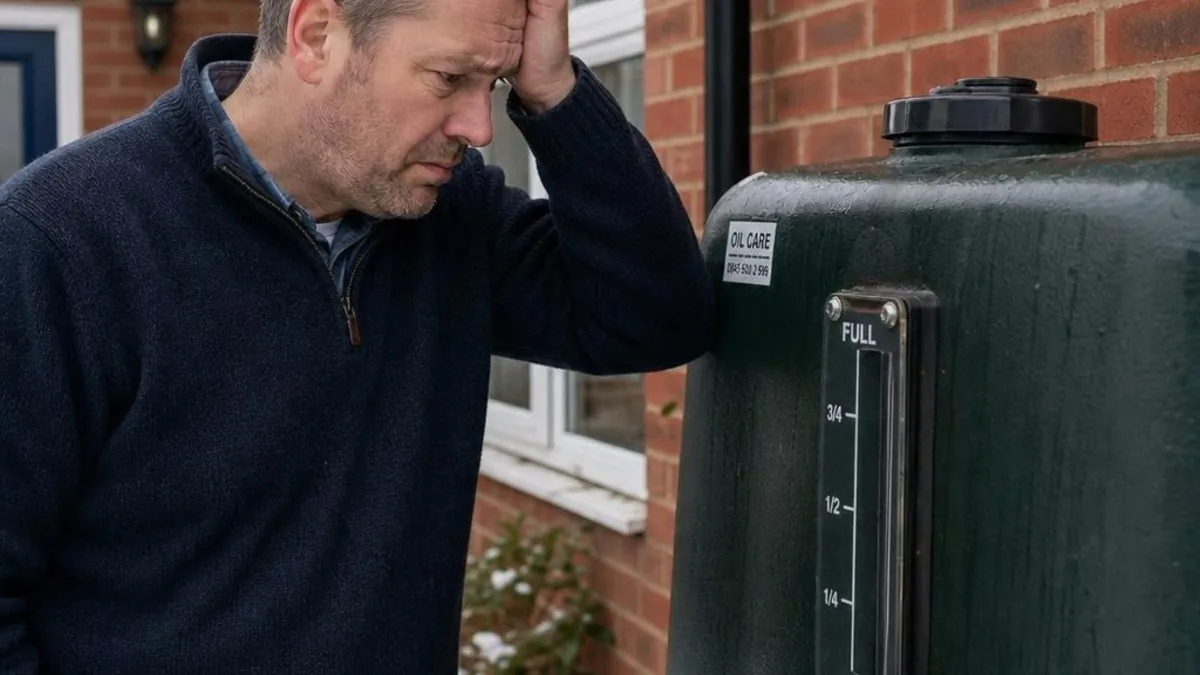
Most domestic tanks have a sight gauge — a clear plastic tube on the side of the tank that shows the current oil level. Check it at least once a month in winter and every two months in summer. If your gauge is cracked, stained or difficult to read, replace it — they are inexpensive and widely available from agricultural merchants.
Some households use a mechanical dip rod to verify the gauge reading. Hold the rod vertically into the tank, then read the wet mark against a calibration chart for your tank model. Digital wireless tank monitors (such as those from Watchman or Tekelek) send level alerts to your phone and are worth considering if your tank is difficult to access or you travel frequently.
Order at the right threshold
The key rule is simple: order when your tank reaches 25% capacity, not when you are close to empty. At 25%, a typical 1,500-litre tank holds around 375 litres — enough for roughly 3 to 5 weeks of normal winter use. This gives you time to compare prices properly and choose a delivery date that suits you, rather than being forced into an emergency order at premium rates.
Resist the temptation to wait until prices fall. Trying to time the oil market is difficult even for professionals. The cost of getting it wrong — an emergency premium plus a potential boiler callout — usually outweighs any saving from waiting a few more weeks.
Plan around lead times
Standard delivery lead times in the UK vary significantly by region and season:
- Summer (May–August) — typically 3 to 7 working days. Some suppliers offer next-day delivery in well-served areas.
- Autumn and early winter (September–November) — demand rises sharply. Lead times of 7 to 14 days are common. Order early.
- Midwinter (December–February) — lead times can extend to 10 to 21 days during cold snaps. Emergency slots may be available at a premium but are not guaranteed.
Use our run-out calculator to enter your current tank level and daily usage and find out exactly when you need to place an order to guarantee delivery before you run dry — even accounting for seasonal lead times.
Consider automatic top-up services
Some suppliers offer an automatic top-up or "AutoFill" service where they monitor local degree-day data (a measure of how cold the weather has been) and deliver oil based on a calculated estimate of your consumption. This removes the need to monitor your tank manually and guarantees you never run out.
The trade-off is that you lose flexibility to shop around at each delivery — you are tied to one supplier's price. AutoFill suits households that prioritise peace of mind over lowest possible price. If you use AutoFill, check your supplier's pricing annually to ensure you are still getting fair value and compare their price with the market using our comparison tool.
What to do if you do run out
If your boiler stops and you suspect you have run dry:
- Check your gauge first — the problem may be a blocked filter or a boiler fault rather than empty oil.
- If the tank is empty, call your supplier or a local emergency heating oil provider. Search for your county using our supplier directory to find local companies with emergency stock.
- Once oil is delivered, the boiler will usually need to be bled to remove air from the fuel line. Some modern boilers have a self-priming function — check the manual. Otherwise, call an OFTEC-registered engineer.
- After the boiler restarts, check the filter — running dry often draws sediment from the bottom of the tank into the fuel line, and a blocked filter is a common cause of boiler lockout after a dry-run.
The best emergency is the one you never have. Set a calendar reminder to check your gauge at the start of every month throughout the heating season, and use the 25% rule to give yourself plenty of lead time for the next order.