
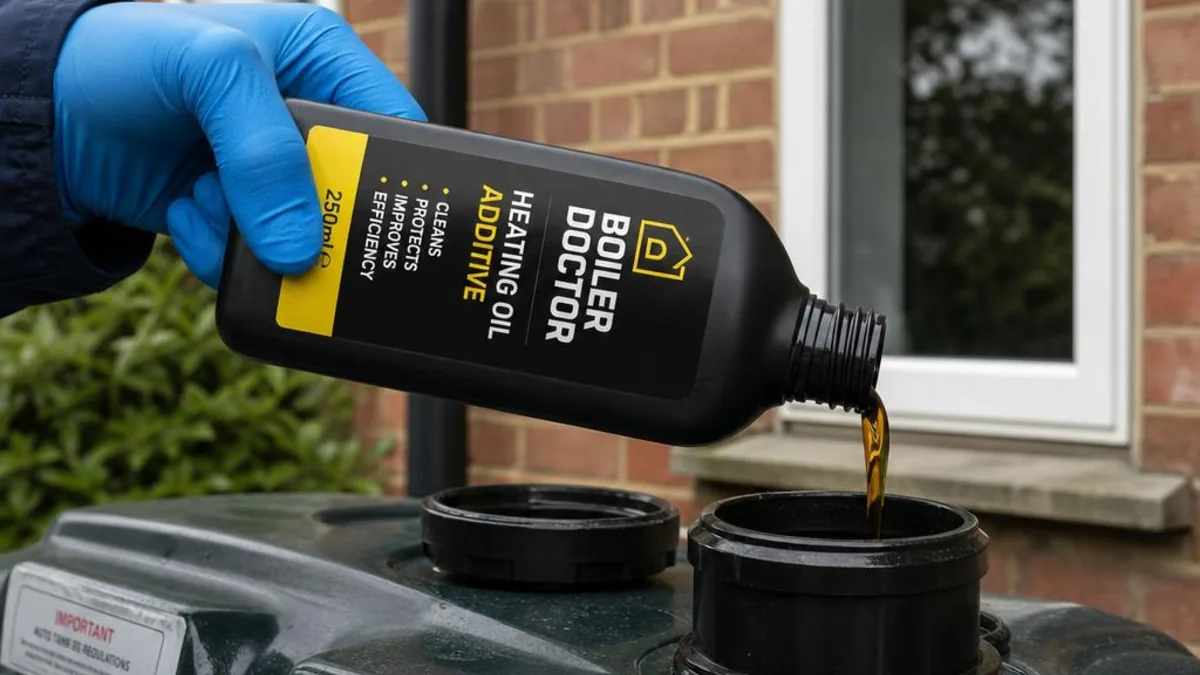
What are heating oil additives?
Heating oil additives are chemical treatments designed to be mixed directly into your kerosene tank. They are sold in bottles of 250 ml to 1 litre and are typically dosed at around 1 ml per litre of oil. Manufacturers claim they improve combustion efficiency, prevent sludge build-up, reduce corrosion inside tanks, and extend the life of boiler components.
The UK market for additives has grown alongside rising energy bills. Several products are widely stocked by agricultural merchants, online retailers, and some heating oil suppliers. The most common brands include Exocet, Fuel Set and Hammerite Kurust-based treatments. However, they are not required by boiler manufacturers, and some warranties specify that only clean, unmodified kerosene should be used.
Types of additive and their claims
Combustion improvers
These claim to make kerosene burn more completely, producing more heat per litre and less sooty residue. In theory, a cleaner burn means the heat exchanger stays cleaner and efficiency holds up between annual services. Independent test data supporting significant real-world efficiency gains is limited.
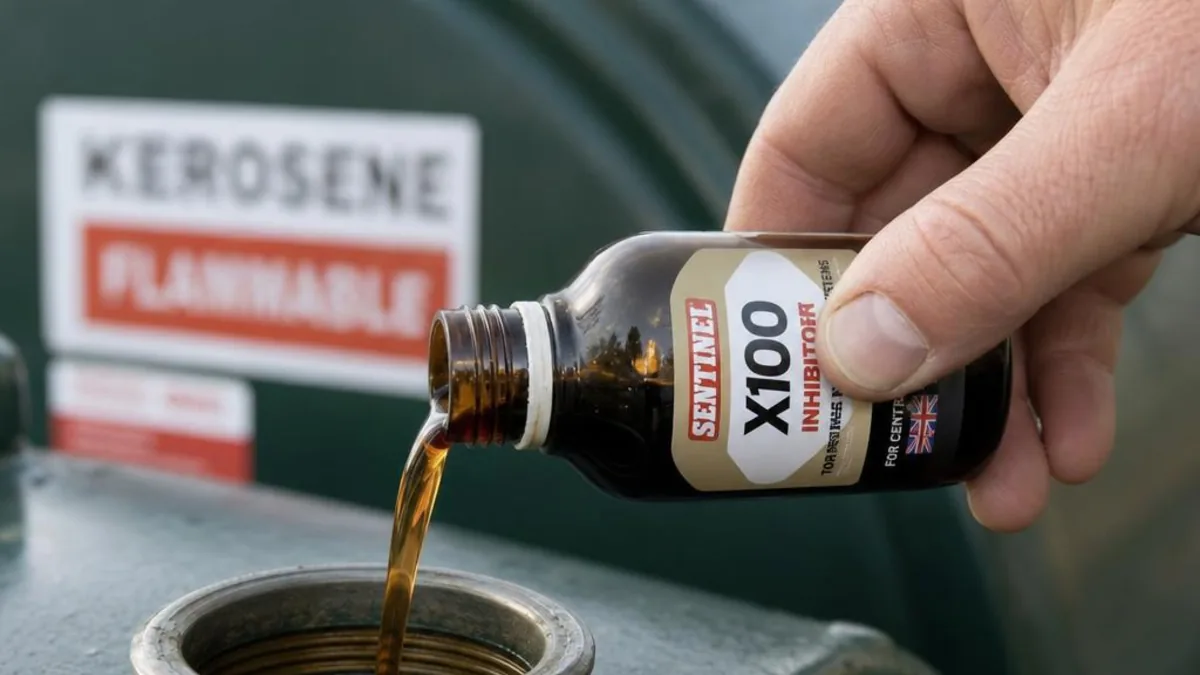
Biocides
A genuine problem with kerosene storage is microbial contamination — bacteria and fungi that feed on the hydrocarbons in oil, producing sludge and acidic by-products that can block filters and corrode metal components. Biocide additives (such as Exocet Anti-Bug) are designed to kill this microbial growth. This is one of the more evidence-backed uses for additives, particularly for tanks that have been partially empty for extended periods or that have had a known contamination problem.
Sludge dispersants
Over time, wax deposits and oxidation by-products can settle at the bottom of tanks. Dispersant additives claim to break up this sediment and keep it suspended so it is burnt rather than blocking the filter. They are most commonly marketed for older steel tanks.
Corrosion inhibitors
These are designed to protect the inside of steel tanks and the internal components of older boilers. Modern plastic (polyethylene) tanks are not susceptible to corrosion, so this type of additive is primarily relevant to ageing steel installations.
Flow improvers
In very cold weather, wax crystals in kerosene can begin to form, reducing the flow rate to the burner. Flow-improver additives are designed to lower the cold filter plugging point (CFPP). In practice, standard BS 2869 Class C2 kerosene is already formulated to perform adequately at UK winter temperatures, and genuine flow problems are uncommon unless a tank is exposed to unusually extreme cold.
What the evidence says
The most credible independent review of heating oil additives in the UK context came from the Energy Saving Trust, which found limited evidence of meaningful efficiency improvements from combustion-improver additives under normal operating conditions. A well-serviced boiler burning clean kerosene performs very close to its rated efficiency without any additive.
Biocides are an exception. OFTEC (the Oil Firing Technical Association) acknowledges that microbial contamination is a real issue, particularly in warm climates or tanks that have sat partially full over a summer. Using a biocide product after a contamination incident, or as a precautionary annual treatment, is considered reasonable practice by many engineers.
Manufacturers' efficiency claims — typically 3 to 10% — should be treated with caution. These figures are rarely produced under controlled independent conditions and often reflect best-case scenarios rather than typical real-world use.
When additives may be worth using
- After a microbial contamination incident — if your filter is repeatedly blocking, your oil looks dark or has a foul smell, a biocide treatment combined with a professional tank clean is appropriate.
- Annual precautionary biocide — if your tank sits partially full over summer, a biocide dose each autumn is inexpensive insurance against contamination.
- Older steel tanks — if you have a steel tank that is showing signs of internal corrosion, a corrosion-inhibitor additive may help slow deterioration while you plan a replacement.
- Blocked or dirty filters — if your boiler engineer finds sludge in the filter at every service, a dispersant additive may help keep debris suspended. However, also investigate whether your tank needs a physical clean.
If your boiler is running well and your tank is a modern plastic model with no history of contamination, additives are unlikely to produce a measurable benefit.
How to use them safely
Always read the manufacturer's dosing instructions. Most additives are added directly to the tank — pour the correct amount in before your oil delivery so the incoming oil mixes with the additive as it fills the tank. Never exceed the recommended dose; over-treating can affect burner performance. Check your boiler manufacturer's documentation to confirm that additives are compatible with your warranty — some manufacturers require that only untreated kerosene is used.
Cost vs benefit
A 1-litre bottle of a well-regarded additive such as Exocet Multi-Purpose Treatment costs around £18 to £25 and treats approximately 1,000 litres of oil. On a typical 1,500-litre annual consumption, the cost is around £25 to £40 per year. For a combustion-improver, the claimed efficiency gain would need to save more than this to justify the spend. For a biocide used as contamination insurance, £25 per year is modest relative to the cost of a filter replacement, a tank clean, or a boiler repair caused by contaminated fuel.
The most reliable saving available to heating oil users is not an additive — it is comparing supplier prices before every order. A 3p per litre difference between suppliers on a 1,000-litre order saves £30 immediately. Use our postcode price comparison to check prices in your area, and our run-out calculator to plan orders before you reach an emergency level.