

What is a buying group?
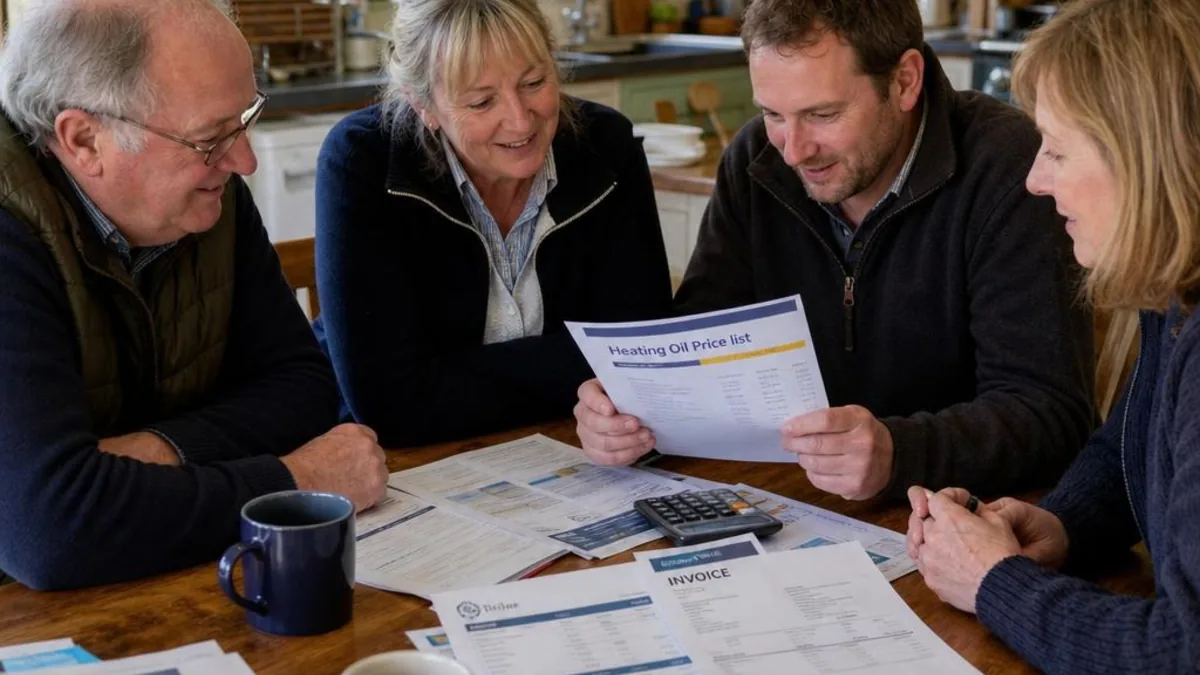
A heating oil buying group — also called a cooperative scheme, community oil scheme or collective buying club — is an organisation where a group of households pool their orders together to negotiate a lower per-litre price from a supplier. By presenting a single large order (often several thousand litres spread across many households), the group has more negotiating power than any individual buyer.
Buying groups exist across rural England, Scotland, Wales and Northern Ireland. Many are run by parish councils, village halls, agricultural societies or community groups. Some operate informally with a coordinator collecting orders by email or phone; others are more formalised with websites and automated ordering systems. Members in Northern Ireland who qualify for the £100 heating oil voucher can put it towards a group order once the scheme opens on 9 September 2026.
How much can you save?
The savings from a buying group depend on the size of the combined order, the group's negotiating skill, the supplier's appetite for the contract and local market conditions. In practice, savings typically range from 2p to 6p per litre versus what individual members could achieve ordering alone at the same time.
On a 1,000-litre individual delivery, 4p per litre saves £40. On 1,500 litres, the saving is £60. Multiplied across many years of deliveries, the cumulative saving is meaningful — but it is important to compare the group's price against the current market each time, rather than assuming the group is always cheapest.
How buying groups work
The mechanics vary, but the most common model works as follows:
- Collection window — the group coordinator announces an order window (often monthly or bi-monthly). Members who want oil indicate their required volume within the window.
- Tender or negotiation — the coordinator contacts two or more suppliers with the total combined volume and requests competitive quotes. The lowest price wins the contract.
- Order confirmation — members are notified of the agreed price per litre. They confirm their order or opt out.
- Delivery schedule — the winning supplier delivers to each member's property individually over the following days, as with a normal delivery. Members pay the supplier directly.
Some buying groups use a third-party platform such as YouChoose (formerly Anglia Buying Group), which operates one of the largest coordinated oil buying networks in the UK. These platforms aggregate demand electronically and tender it automatically, making the process more efficient than a manually coordinated village scheme.
Pros and cons
Pros
- Can achieve prices below what an individual buyer can negotiate, particularly for very large combined orders
- Low effort once you are a member — the coordinator does the price negotiation
- Community benefit — supports local coordination and helps neighbours who are less confident about buying online
- Some schemes have relationships with local suppliers and can negotiate emergency delivery priority for members
Cons
- Order windows are fixed — if you need oil urgently outside the window, you must order independently
- You cannot compare prices at the time of order — the group commits to one supplier, which may not always be the market cheapest
- Group prices are not always competitive — some schemes negotiate infrequently or have an arrangement with a single supplier that limits competition
- Coordination depends on a volunteer — if the coordinator moves away or steps down, the group may fold
- No transparency on how tender responses compared — you may not know whether a better deal was available
How to find a buying group
Start with your parish council or village hall — these are the most common organisers of local schemes. Your local agricultural merchant or rural business association may also know of active groups in your area.
For a more systematic search:
- YouChoose (youchoose.co.uk) — one of the largest coordinated buying networks, covering much of rural England
- Home Heat Helpline — a government-backed service that can signpost community energy schemes in your area
- OFTEC regional contacts — OFTEC sometimes has knowledge of local schemes through its installer network
- Facebook local community groups — many informal village oil schemes are now coordinated through local Facebook groups
If no group exists in your area, starting one is simpler than it sounds. Contact your parish council, put a note in the village newsletter and trial a coordinated order with a dozen or more households. With a combined order of 5,000+ litres, you will have real negotiating power.
Buying groups vs price comparison
Buying groups and price comparison services are not mutually exclusive — they serve different needs. A price comparison tool like Compare My Heating Oil lets you put a single request in front of several named suppliers at once, whenever it suits you. A buying group negotiates a collective price on a fixed schedule.
The smart approach is to use both: when your group announces its price, ask two or three suppliers covering your postcode for their own quote the same day. If the group price is close, the group wins on simplicity. If the open market is materially cheaper, you have a data point to bring back to your group coordinator for future negotiations.
Use our supplier finder to see which suppliers deliver to your postcode before your next order — whether through a group or independently.